
Key takeaways
- Industrial marketing has to reach technical buyers who decide in committees and take months to choose.
- Map every role in the buying committee and speak to each one’s concerns.
- Useful technical content builds trust before the first sales call.
- Lead quality improves with targeting, qualifying forms, nurturing and fast follow-up.
A marketing strategy for industrial products starts with buyer research, targets defined accounts, speaks to every member of the buying committee, uses technical content to build trust, and supports sales with fast, consistent follow-up.
Marketing a pump, a CNC machine, a packaging line, or an industrial coating is very different from marketing a pair of sneakers. The buyers are engineers, plant managers, and procurement teams. The sales cycle can take months. Several people have to agree before anyone signs a purchase order. And the cost of choosing the wrong supplier can be high.
Because of that, a marketing strategy for industrial products has to earn trust, explain technical value clearly, and support a long buying process. Flashy campaigns rarely work on their own. What works is being genuinely useful to the people who make and influence the decision.
This guide covers how industrial marketing differs from consumer marketing, how to build a practical strategy, the role of content, current trends, and how to turn more of your marketing into qualified sales conversations.
Table of contents
- What Is Industrial Marketing?
- How Industrial Goods Can Be Marketed
- Building a Marketing Strategy for Industrial Products
- Industrial Content Marketing
- Industrial Marketing Trends in 2026
- How Industrial Marketing Services Improve Lead Quality
- Following Up on Industrial Leads
- Frequently Asked Questions
- Final Thoughts
What Is Industrial Marketing?
Industrial marketing, sometimes called industrial sector marketing, is the marketing of products and services from one business to another for use in production, operations, or maintenance. It includes raw materials, components, machinery, tools, industrial software, and services such as maintenance or engineering.
It is a type of B2B marketing, but with some features that make it distinct.
How industrial marketing is different
- Multiple decision makers. Engineers care about specifications, operations cares about uptime, finance cares about cost, and procurement cares about terms. Your marketing needs to speak to each of them.
- Long sales cycles. Large purchases may take months of evaluation, testing, and approvals.
- Technical buyers. Many buyers know the subject deeply and will spot vague claims quickly.
- Relationship-driven. Repeat orders, service contracts, and long-term supply relationships matter a lot.
- Smaller, defined markets. You may be selling to a few thousand potential companies, not millions of consumers.
How is industrial marketing different from other B2B marketing?
A: It has more technical buyers, larger buying committees, longer sales cycles and smaller, well-defined markets.
How Industrial Goods Can Be Marketed
A common question is how industrial goods can be marketed when the audience is narrow and technical. In practice, industrial companies use a mix of channels:
- Direct sales teams that build relationships with key accounts.
- Distributors and dealers that reach smaller customers and regional markets.
- Trade shows and industry events where buyers can see equipment in person.
- Websites and technical content that answer questions during research.
- Search engine optimization and paid search for buyers actively looking for solutions.
- Email marketing and nurturing to stay in touch through long sales cycles.
- Trade publications and industry associations.
- LinkedIn and other professional networks.
- Case studies, application notes, and product demonstrations.
The right mix depends on your product, price point, and market. A supplier of high-volume components might rely heavily on distributors and online catalogues. A maker of custom machinery might focus on direct sales, trade shows, and in-depth case studies.
Related read: Lead Generation Starts With a Better Intake Form
Building a Marketing Strategy for Industrial Products
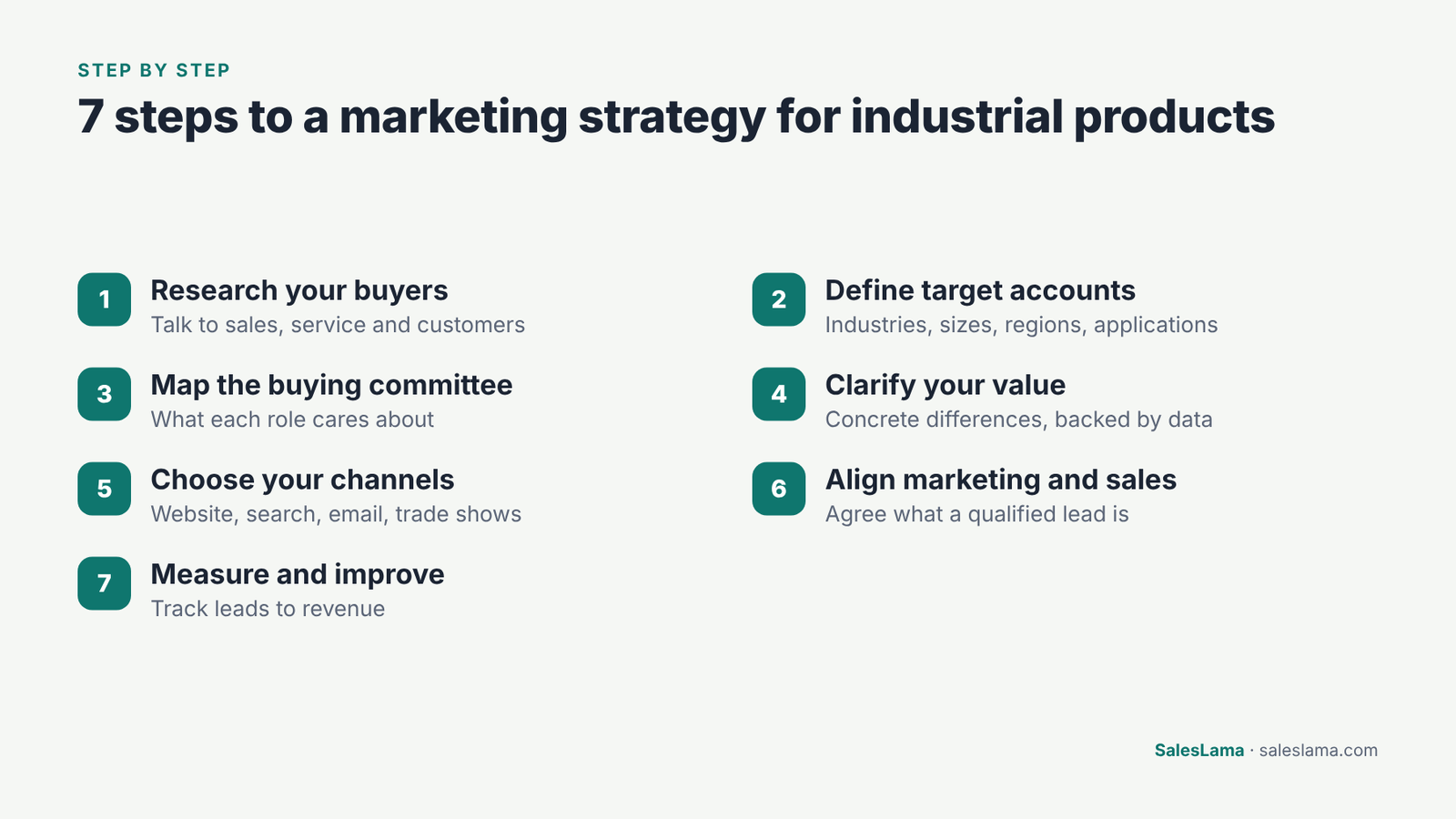
Here is a step-by-step approach that works for most industrial businesses.
Step 1: Do your industrial marketing research
Start by understanding your buyers. Talk to your sales team, your service technicians, and your best customers. Ask:
- Who is involved in the buying decision?
- What problem were they trying to solve when they found you?
- Where did they look for information?
- What almost made them choose a competitor?
- What questions came up repeatedly during the sale?
Industrial marketing research does not have to be expensive. A dozen honest conversations with customers often reveal more than a large survey.
Step 2: Define your target accounts and segments
Industrial markets are usually small enough to be specific. Define the industries, company sizes, regions, and applications you serve best. If you can name the companies you want to win, list them. This allows targeted campaigns instead of broad advertising.
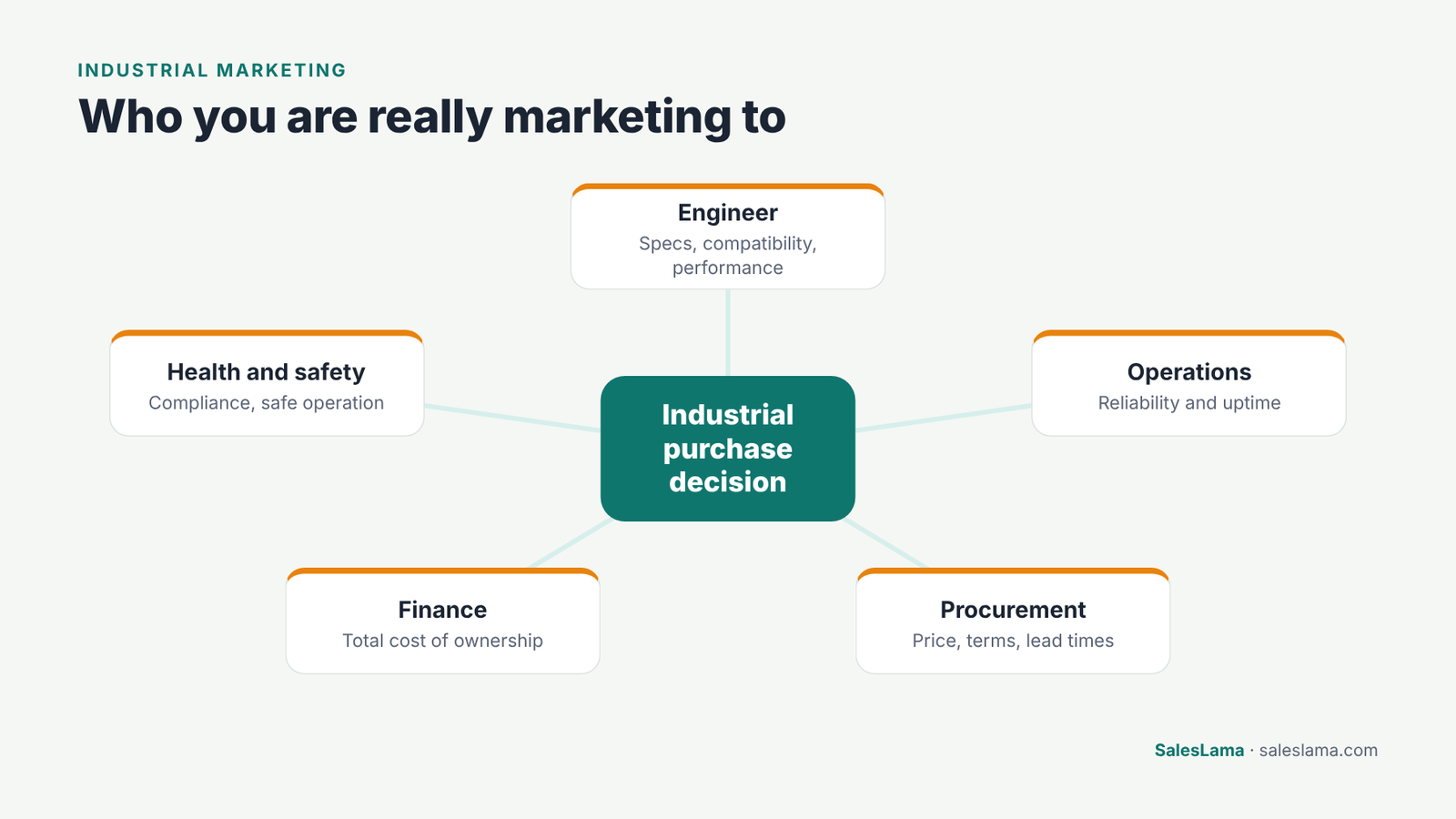
Step 3: Map the buying committee
For each segment, list the roles involved and what each one cares about. For example:
| Role | Main concerns |
|---|---|
| Design or process engineer | Specifications, compatibility, performance |
| Plant or operations manager | Reliability, downtime, ease of maintenance |
| Procurement | Price, terms, supplier stability, lead times |
| Finance | Total cost of ownership, return on investment |
| Health and safety | Compliance, safe operation |
Your content and messages should cover each role’s concerns, not just the engineer’s.
Step 4: Clarify your value proposition
Explain in plain language what makes your product better for a specific application. Avoid generic claims like “high quality” and “innovative solutions.” Instead, explain concrete differences, such as longer service intervals, easier installation, or better performance in a particular environment. Back up claims with test data, certifications, or customer results where you have them. Technical buyers are quick to tune out anything that sounds salesy.
Step 5: Choose your channels
Pick a manageable set of channels based on where your buyers actually look. For many industrial companies, the core is a strong website, search, email, trade shows, and the sales team. Add others only once these are working.
Step 6: Align marketing and sales
In industrial businesses, marketing rarely closes the deal. Its job is to create and warm up opportunities for sales. Agree with the sales team on what a qualified lead looks like, how leads are handed over, and how quickly sales will follow up. A good handover passes on everything the lead has already said, which is why a CRM handoff should never lose context.
Step 7: Measure and improve
Track where leads come from, which ones become opportunities, and which turn into revenue. Over time, this shows which industrial marketing campaigns are worth repeating.
Industrial Content Marketing
Content is especially important in industrial marketing because buyers research heavily before talking to a supplier. Industrial content marketing means creating useful material that helps buyers understand problems, compare options, and justify decisions internally.
Content types that work well
- Application notes explaining how a product solves a specific problem in a specific setting.
- Case studies showing real results at a customer site.
- Technical guides and white papers that go deep on a topic.
- Product selection guides and calculators that help buyers choose the right model.
- Comparison pages explaining the differences between technologies or approaches.
- Videos of products in operation, installation steps, or maintenance tips.
- FAQs that answer common questions from sales calls.
- An industrial marketing blog that covers practical topics your buyers search for.
Tips for better industrial content
- Write for the expert. Avoid oversimplifying, but explain clearly.
- Answer real questions from your sales and service teams.
- Include specifications, drawings, and data where useful.
- Make technical documents easy to find and download.
- Show your people. Engineers trust other engineers.
What content works best for industrial buyers?
A: Application notes, case studies, technical guides, selection tools and videos that answer real questions from sales calls.
Industrial Marketing Trends in 2026
Several trends in industrial marketing have become more noticeable in recent years.
Buyers research more before contacting suppliers
More of the research happens online before a buyer ever talks to sales. That makes your website, content, and search visibility more important.
Digital and in-person are blended
Trade shows remain valuable, but they increasingly connect to digital follow-up. Visitors who stop at a booth expect a quick, relevant follow-up afterwards, not a generic brochure weeks later. Our sales introduction email examples include a post-event template you can adapt.
Account-based industrial marketing
Because industrial markets are well defined, many companies focus marketing on specific target accounts, with tailored content and outreach for each.
Video and visual content
Showing equipment in action, installation, and maintenance helps buyers understand products faster than text alone.
Industrial marketing automation
Long sales cycles mean leads need to be nurtured over months. Automated email and messaging sequences help keep in touch without relying on someone remembering.
Greater focus on lead quality
Many industrial companies are moving away from chasing large numbers of leads and toward fewer, better-qualified ones that sales can actually close.
Follow up on every trade show lead and quote request
SalesLama replies to new industrial leads instantly, nurtures them through long sales cycles and hands hot leads to sales.
How Industrial Marketing Services Improve Lead Quality
Some companies work with specialist agencies or industrial marketing services. Others build these skills in-house. Either way, a few practices make the biggest difference to lead quality:
- Better targeting. Focus campaigns on the industries and roles that actually buy.
- Qualifying forms. Ask a few useful questions on enquiry forms, such as application, quantity, or timeline. (More on this in lead generation starts with a better intake form.)
- Nurturing. Not every lead is ready now. Send early-stage leads into a nurture sequence instead of passing them straight to sales.
- Lead scoring or tagging. Flag leads that show strong interest, such as requesting a quote or opening several technical emails.
- Fast follow-up. A quote request that waits days for a response sends a poor signal about how you will treat a customer.
Following Up on Industrial Marketing Leads
Industrial companies often spend heavily to generate leads, then lose a share of them through slow or inconsistent follow-up. A trade show visitor scans their badge and hears nothing for two weeks. A website enquiry lands in a shared inbox that nobody owns. Both are classic bad sales habits that quietly cost deals.
SalesLama is a CRM and lead automation platform that can help close those gaps. Leads from website forms, landing pages, tablet sign-in forms at events, ad platforms through webhooks, and CSV imports land in one place. Campaigns can send an immediate personalized reply by email, SMS, or WhatsApp, branch based on replies, tags, or email opens, assign an owner, create tasks, and move leads through pipeline stages. Automated steps stop when the lead replies so your sales team can take over.
SalesLama’s ready-made templates are built mainly for real estate, so an industrial company would build its own campaigns, such as trade show follow-up or quote request nurturing. If you want to test it, you can start a free trial here.
Frequently Asked Questions
What is an industrial marketing strategy?
It is a plan for reaching and winning business customers who buy products or services for production, operations, or maintenance. It covers target markets, value proposition, channels, content, and how marketing supports sales.
How can industrial goods be marketed?
Through direct sales, distributors, trade shows, websites, search, technical content, email marketing, trade publications, and professional networks, usually in combination.
Why is content marketing important for industrial companies?
Industrial buyers research heavily before contacting suppliers. Useful content helps them understand your products and builds trust before the first sales conversation.
What are the current trends in industrial marketing?
More online research by buyers, blended digital and in-person marketing, account-based marketing, video content, marketing automation, and a stronger focus on lead quality.
How can I improve the quality of industrial leads?
Target the right industries and roles, use qualifying questions on forms, nurture early-stage leads, flag high-interest leads, and follow up quickly.
Related reading: for more practical guides, see ATL, BTL and TTL marketing, MQL vs SQL vs PQL handoffs and TAM SAM SOM market sizing.
Final Thoughts
A strong marketing strategy for industrial products starts with understanding your buyers, speaking to every member of the buying committee, and creating content that helps them make a confident decision. Combine that with steady follow-up through long sales cycles, and more of your marketing turns into real opportunities.
If slow or inconsistent lead follow-up is a weak spot, take a look at SalesLama and create your free account.
Ready to stop losing leads to slow follow-up?
SalesLama replies to new leads in seconds, follows up by email, SMS and WhatsApp, and hands hot leads to your team when they reply.