
Key takeaways
- An ecommerce CRM strategy turns one-time buyers into repeat customers.
- Segmentation is the foundation of every other CRM technique.
- Start with a welcome sequence and post-purchase follow-up, then add reviews, alerts and win-backs.
- Use each channel for what it does best, and always get consent.
An ecommerce CRM strategy uses customer data, like what people bought and how they engage, to send relevant, well-timed messages that bring them back. Start with segmentation, a welcome sequence and post-purchase follow-up.
Getting a first order from a new customer is hard work. You pay for ads, optimize product pages, and offer discounts. Then, too often, that customer buys once and never hears from you again, or hears only generic newsletters that have nothing to do with what they bought.
An ecommerce CRM strategy fixes that. It uses what you know about each customer, such as what they bought, when, and how they engage, to send more relevant messages and build a relationship that leads to repeat purchases.
This article covers what an ecommerce CRM does, then walks through 10 practical CRM techniques you can use to keep customers coming back.
Table of contents
Ecommerce CRM Strategy Basics: What Is an Ecommerce CRM?
CRM stands for customer relationship management. In ecommerce, a CRM brings together customer data from your store, email, SMS, and support channels so you can see each customer as a person, not just an order number.
A typical ecommerce CRM stores:
- Contact details and communication preferences.
- Purchase history and order values.
- Browsing or engagement signals, such as email opens and clicks.
- Support conversations.
- Tags and segments, such as “VIP,” “first-time buyer,” or “kids’ products.”
With this information, you can send the right message to the right customer at the right time, instead of sending the same email to everyone.
How is a CRM different from an email marketing tool?
A: Email tools send campaigns. A CRM keeps the full customer record, including conversations, tags and history across channels.
Why Ecommerce Stores Need a CRM Strategy
Without a plan, most stores fall into one of two traps. Either they rarely contact customers after the first sale, or they blast everyone with the same promotions. Both leave money on the table.
A clear CRM strategy helps you:
- Turn first-time buyers into repeat customers.
- Increase average order value with relevant recommendations.
- Bring back customers who have gone quiet.
- Collect more reviews and user-generated content.
- Reduce support load by answering common questions proactively.
- Understand which customers are most valuable.
Related read: Sales and Customer Service: How They Differ and Why They Need Each Other
10 CRM Techniques for Your Ecommerce Strategy
1. Segment your customers
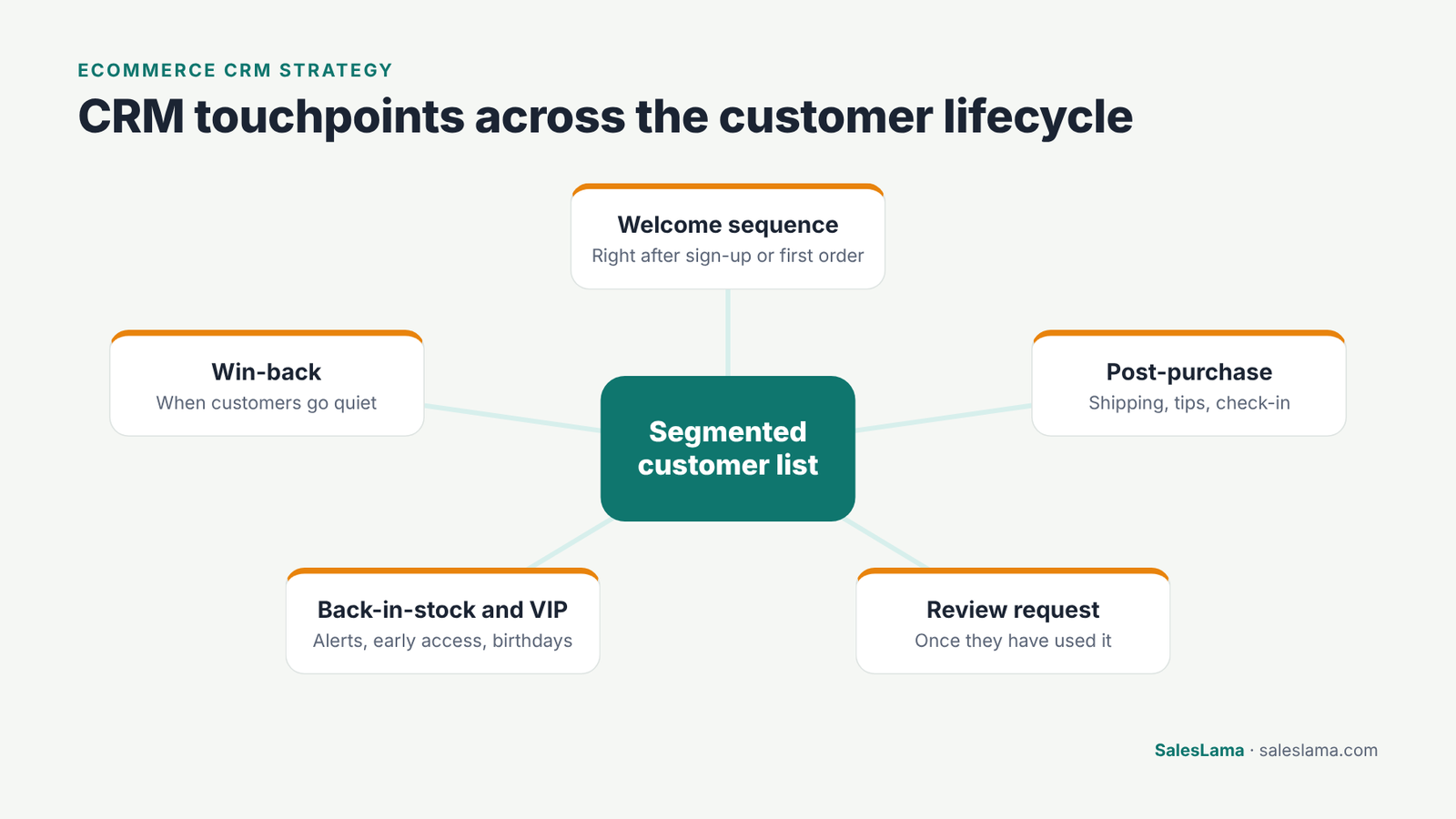
Segmentation is the foundation of every good CRM tactic. Group customers by things that change what they want to hear about:
- Purchase history: what categories or products they bought.
- Recency: how long since their last order.
- Frequency: how often they buy.
- Value: how much they spend.
- Engagement: whether they open and click your messages.
- Location: useful for shipping offers, events, or local stock.
Even a few simple segments make a big difference. A promotion for kids’ shoes sent only to customers who bought kids’ products performs better and annoys fewer people than one sent to your whole list.
2. Send a proper welcome sequence
The period right after someone subscribes or makes a first purchase is when they pay the most attention. Use it.
A simple welcome sequence might include:
- A thank-you message with what to expect.
- A short story about your brand or how your products are made.
- Helpful content, such as how to use or care for the product.
- A gentle prompt to explore related products.
Many stores collect newsletter sign-ups and then send nothing for months. A welcome sequence turns that interest into a relationship.
3. Follow up after every purchase
Post-purchase messages build trust and set up the next sale. Consider:
- Order confirmation and shipping updates.
- A “how is it going?” check-in a few days after delivery.
- Usage tips or care instructions.
- A review request once they have had time to try the product.
4. Ask for reviews at the right time
Reviews help new customers decide to buy. Many stores never ask, or ask too early, before the product has arrived.
Time your review request to when the customer has had a chance to use the product. For a T-shirt, that might be a week after delivery. For a skincare product, maybe a few weeks. Make it easy with a direct link and a short message.
5. Use back-in-stock alerts
If customers keep asking “Is it back in stock?”, that is demand you can capture. Let customers sign up for alerts on out-of-stock items, then message them automatically when the item returns. These messages tend to be welcome because the customer asked for them.
6. Reward your best customers
Your most loyal customers deserve special treatment. Ideas include:
- Early access to new products or sales.
- Exclusive offers for VIP segments.
- Birthday messages with a small gift or discount.
- Personal thank-you notes after a milestone order.
Timing matters. Announcing a VIP early-access sale at midnight, when nobody sees it until it is half over, wastes the goodwill. Schedule messages for when customers are likely to read them.
7. Recover abandoned carts and browsing
When someone adds items to a cart and leaves, a reminder can bring them back. Keep cart reminders helpful rather than pushy. A first reminder within a few hours, and perhaps one more a day later, is usually enough. Answer common hesitations, such as shipping costs, returns, or sizing. The same principles behind a good gentle reminder email apply here.
8. Win back inactive customers
Customers who have not bought in a long time are not necessarily lost. They may have forgotten about you. A win-back campaign reminds them with:
- What is new since their last visit.
- Products related to what they bought before.
- A simple question asking if they would like to hear from you less often.
If they still do not engage, it can be healthier to reduce messages to them than to keep sending.
9. Use more than one channel
Email works well for detailed content, product showcases, and newsletters. SMS works well for short, time-sensitive messages like shipping updates and limited offers. WhatsApp is the preferred channel for many customers in some regions. Your CRM strategy should use each channel for what it does best and respect each customer’s preferences.
Always get proper consent for marketing messages, especially for SMS and WhatsApp, and follow the messaging rules that apply in the countries where you sell.
10. Connect sales and support conversations
When a customer contacts support, the agent should see their order history. When a support conversation reveals a product need, it should be easy to tag that customer for a relevant follow-up. A shared view of customer conversations keeps everyone on the same page. Read more on how sales and customer service work together.
Automate welcome flows, alerts and win-backs
SalesLama runs personalised email, SMS and WhatsApp campaigns triggered by your store, forms or customer birthdays.
Putting Your Ecommerce CRM Strategy Together
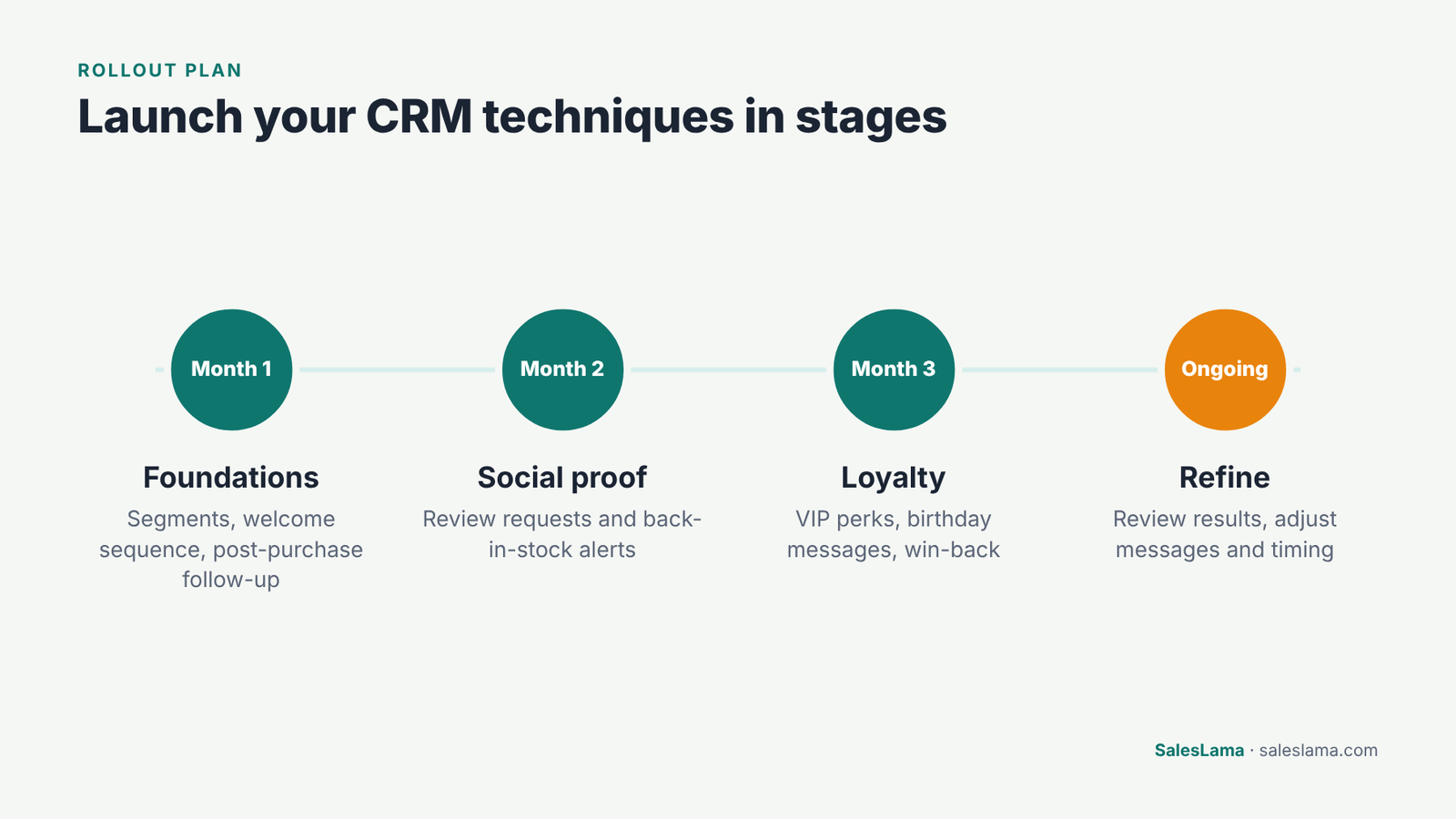
You do not need to launch all ten techniques at once. A practical rollout looks like this:
| Phase | Focus |
|---|---|
| Month 1 | Basic segments, welcome sequence, post-purchase follow-up |
| Month 2 | Review requests, back-in-stock alerts |
| Month 3 | VIP program, birthday messages, win-back campaign |
| Ongoing | Review results and refine messages and timing |
Start with the techniques that affect the most customers, then build out from there.
Which CRM technique should an online store start with?
A: Segmentation, a welcome sequence and post-purchase follow-up, because they affect the most customers.
Measuring Your Ecommerce CRM Strategy
Track a small set of numbers to see if your CRM tactics are working:
- Repeat purchase rate: the share of customers who buy more than once.
- Time between orders: whether customers are coming back sooner.
- Customer lifetime value: how much revenue a customer brings over time.
- Engagement: opens, clicks, and replies by segment.
- Unsubscribes and complaints: a sign you may be sending too often or the wrong content.
Look for trends over several months rather than reacting to a single campaign.
Ecommerce CRM Strategy Mistakes to Avoid
Sending everything to everyone. Untargeted messages reduce engagement and increase unsubscribes.
Only sending promotions. Customers tune out if every message is a discount. Mix in useful content. A feed of nothing but offers is a fast way to sound salesy.
Ignoring timing. A great message sent at the wrong time gets missed.
Collecting data you never use. If you ask for birthdays or preferences, act on them.
Forgetting consent. Make sure you have permission to contact customers on each channel.
How SalesLama Supports Your Ecommerce CRM Strategy
SalesLama is a CRM and lead automation platform that supports e-commerce and retail businesses alongside its real estate focus. It can bring in contacts from forms, CSV and Excel imports, and other tools through webhooks or Zapier and Make, then run automated campaigns by email, SMS, and WhatsApp.
You can use tags to segment customers, trigger campaigns from form submissions, webhooks, or birthdays, add waits between steps, and branch based on replies, tags, or email opens. Replies arrive in a shared inbox, and campaigns stop when a customer replies so a person can respond. You write the messages, so they match your brand voice. (See how to automate follow-up without losing the human thread.)
SalesLama’s ready-made templates are built mainly for real estate, so an online store would set up its own campaigns, such as a welcome sequence or a back-in-stock alert triggered from your store through a webhook. If you want to test it, you can start a free trial here.
Frequently Asked Questions
What is an ecommerce CRM strategy?
It is a plan for using customer data to send more relevant messages, build relationships, and increase repeat purchases.
What are the most effective CRM techniques for online stores?
Segmentation, welcome sequences, post-purchase follow-up, review requests, back-in-stock alerts, VIP rewards, cart recovery, and win-back campaigns are among the most useful.
How is a CRM different from an email marketing tool?
Email marketing tools focus on sending campaigns. A CRM keeps a fuller record of each customer, including conversations, tags, and history across channels, and often supports tasks and team collaboration.
Should ecommerce stores use SMS and WhatsApp?
They can work very well for short, timely messages, but only with clear customer consent and in line with local messaging rules.
How often should I message my customers?
It depends on your products and audience. Watch engagement and unsubscribe rates. If they get worse, you may be sending too often or sending the wrong content.
Related reading: for more practical guides, see managed live chat vs live chat software, how sales and customer service work together and CRM and sales enablement tools.
Final Thoughts on Ecommerce CRM Strategy
A good ecommerce CRM strategy is not about sending more messages. It is about sending better ones: relevant, well timed, and based on what each customer actually bought and cares about. Start with segmentation, a welcome sequence, and post-purchase follow-up, then add more CRM tactics as you learn what works.
If you want to automate personalized email, SMS, and WhatsApp campaigns, take a look at SalesLama and create your free account.
Ready to stop losing leads to slow follow-up?
SalesLama replies to new leads in seconds, follows up by email, SMS and WhatsApp, and hands hot leads to your team when they reply.