Key takeaways
- Sales and customer service work best together: sales wins new customers and customer service keeps them buying.
- Customers see one company, so gaps between teams hurt trust.
- Share one customer record and create a clear handoff after every sale.
- Measure shared goals like retention, not just deals and ticket speed.
Sales helps prospects decide to buy, while customer service helps existing customers succeed. They work best as one team, with a single customer record, a clear handoff process and shared goals like retention.
Many businesses treat sales and customer service as two separate worlds. Sales finds new customers and closes deals. Customer service handles questions and problems afterwards. Each team has its own goals, its own tools, and sometimes its own opinion of the other.
Customers do not see it that way. To them, it is one company. If the salesperson promised something that support cannot deliver, or if a support agent has no idea what the customer was told during the sale, the customer just feels let down.
This article explains the difference between sales and customer service, where they overlap, the role of customer service in sales, and practical ways to get both teams working together.
Table of contents
- What Is the Difference Between Sales and Customer Service?
- The Role of Customer Service in Sales
- The Role of Sales in Customer Service
- Where Things Go Wrong
- How to Align Sales and Customer Service
- A Real Estate Example
- Skills Both Teams Share
- Tools That Help Both Teams
- Frequently Asked Questions
- Final Thoughts
What Is the Difference Between Sales and Customer Service?
The simplest way to describe the difference is by timing and purpose.
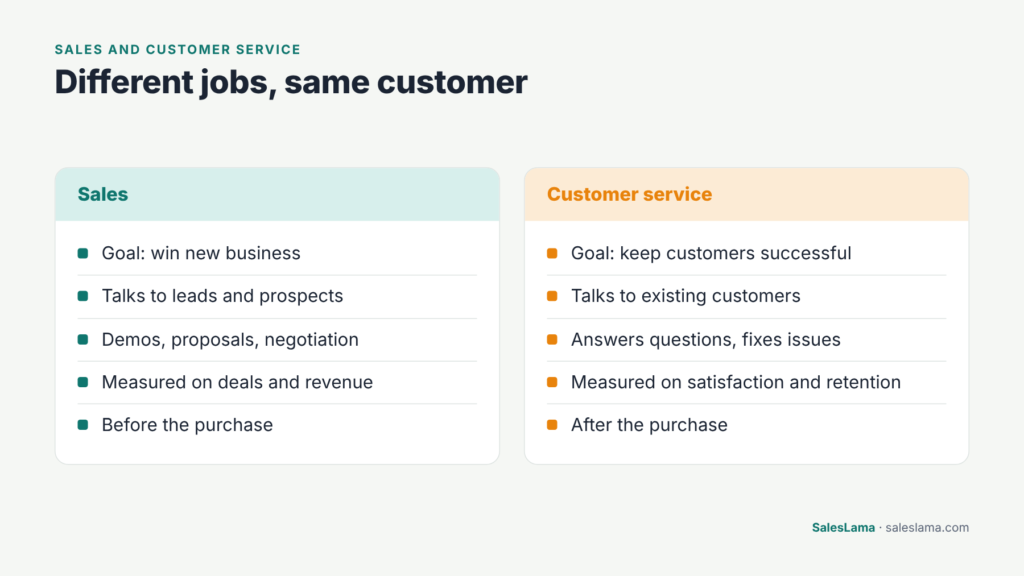
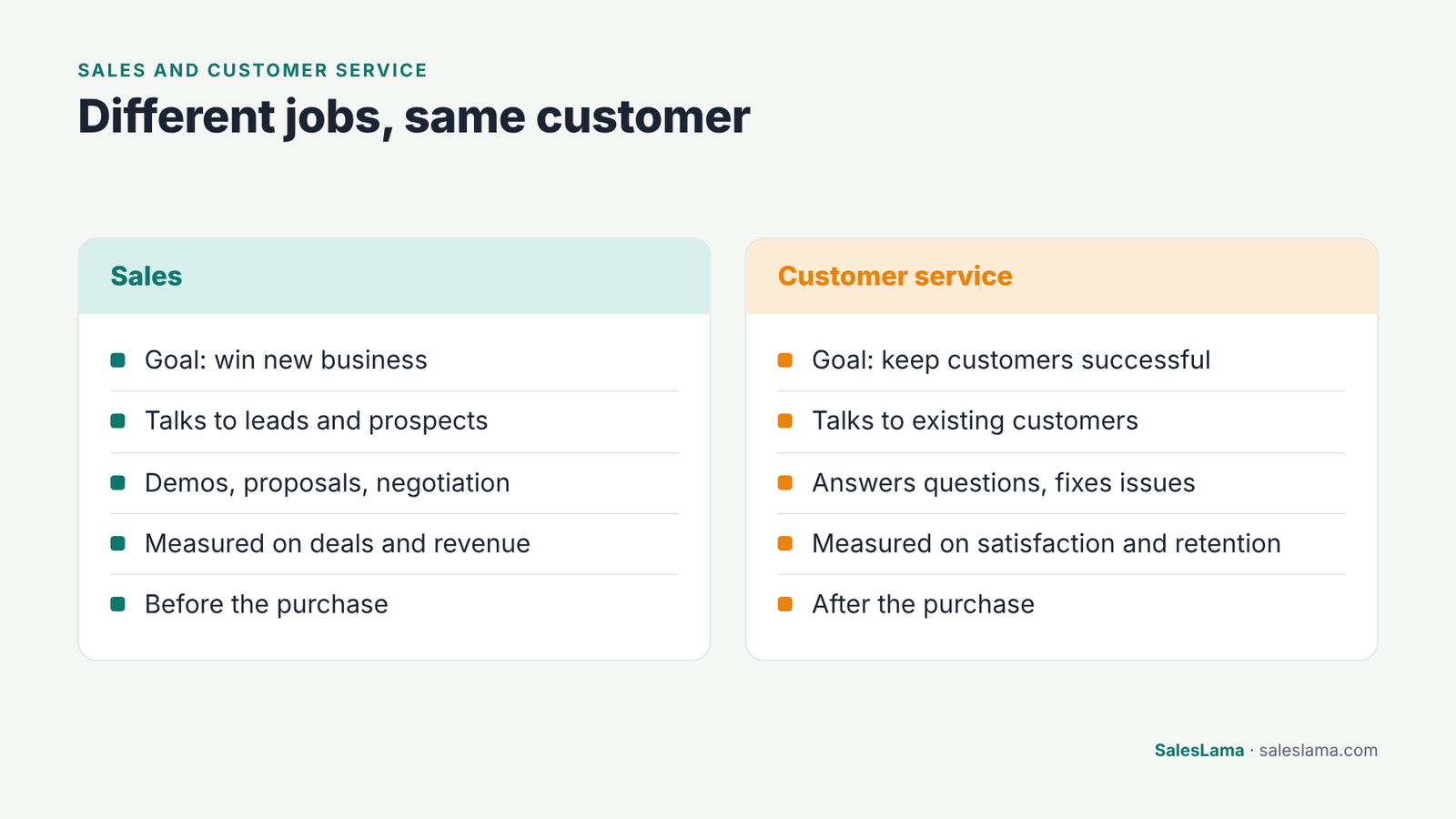
Sales focuses on helping potential customers decide to buy. It includes finding leads, understanding their needs, explaining options, handling objections, and closing deals.
Customer service focuses on helping existing customers get value from what they bought. It includes answering questions, solving problems, handling complaints, and making sure customers are satisfied.
Here is a side-by-side view:
| Sales | Customer service | |
|---|---|---|
| Main goal | Win new business | Keep customers happy and successful |
| Who they talk to | Leads and prospects | Existing customers |
| Typical activities | Prospecting, demos, proposals, negotiation | Answering questions, fixing issues, guiding customers |
| Common measures | Deals closed, revenue, conversion rate | Satisfaction, resolution time, retention |
| Timing | Before the purchase | After the purchase |
In reality, the line is not that neat. Salespeople serve customers, and service teams often influence sales.
Can customer service help increase sales?
A: Yes. Good service drives repeat purchases, referrals and reviews, and support teams often spot upgrade opportunities.
The Role of Customer Service in Sales
Good customer service is part of good selling. Here is why.
Service during the sale builds trust
Prospects judge your company by how you treat them before they buy. Quick replies, clear answers, and honest advice are customer service skills. A salesperson who helps a buyer understand their options, even when the answer is “this product is not right for you,” earns trust that pays off later.
Service after the sale creates repeat business
Customers who have a good experience are more likely to buy again, upgrade, or renew. In many businesses, repeat customers are a large share of revenue. Online stores can build this deliberately with an ecommerce CRM strategy.
Happy customers bring referrals
Referrals usually come from customers who felt well looked after. In industries like real estate, home services, and professional services, referrals can be one of the most valuable lead sources.
Reviews influence new buyers
Online reviews often mention service. A buyer comparing two businesses will notice comments like “they always called back quickly” or “they never answered my emails.” For trade businesses, automated review requests are one of the first things to set up in a CRM, as we explain in our guide to the best CRM for Australian tradies.
The Role of Sales in Customer Service
The relationship works in the other direction too. Sales in customer service shows up in several ways.
Service teams spot opportunities
Support agents hear about customer needs every day. A customer asking how to do something the product cannot do may need an upgrade. A customer mentioning a new location might need more licences or services. Passing these signals to sales creates warm opportunities.
Service conversations can lead to upsells
When done carefully, suggesting a relevant product or service during a support conversation helps the customer. The key is that it must genuinely solve their problem, not feel like a pitch at the wrong moment. Anything else quickly feels salesy.
Retention is a form of selling
Keeping a customer who was thinking of leaving is often worth as much as winning a new one. Service teams that handle problems well protect revenue that sales worked hard to win.
Related read: A CRM Handoff Should Never Lose Context
Where Sales and Customer Service Go Wrong
When sales and customer service are not aligned, customers feel the gaps.
Overpromising. A salesperson says a product can do something it cannot, or promises a timeline that is unrealistic. Customer service inherits an unhappy customer.
Missing information. Service has no record of what the customer was told during the sale. The customer has to repeat everything.
Slow handoffs. After the deal closes, the customer waits days to hear from anyone. Excitement turns into doubt.
Blame between teams. Sales blames support for unhappy customers. Support blames sales for bad promises. Nobody fixes the root cause.
Different tools. Sales uses one system and service uses another, with no shared view of the customer.
What is the most common gap between sales and service?
A: Missing information at handoff, which forces customers to repeat themselves after the sale.
How to Align Sales and Customer Service
1. Share one customer record
Both teams should be able to see the customer’s history: what they bought, what they were told, past conversations, and open issues. A shared CRM or shared inbox makes this possible. When anyone talks to the customer, they have the full picture.
2. Create a clear handoff process
Decide what happens right after a sale. Who contacts the customer, when, and with what information? (We cover this in detail in a CRM handoff should never lose context.) A simple checklist helps:
- Key details from the sales process recorded in the CRM.
- Any promises or special terms noted clearly.
- A welcome message sent within a set time.
- An owner assigned on the service side.
- A first check-in scheduled.
3. Set honest expectations during the sale
Train salespeople to describe what the product does accurately, including its limits. Customers forgive limitations they knew about. They do not forgive surprises.
4. Pass signals both ways
Create an easy way for service to flag sales opportunities and for sales to flag customers who need extra care. A simple tag or task in the CRM can be enough.
5. Hold regular check-ins between teams
A short monthly meeting where sales and service share what they are hearing from customers can surface problems early. Common complaints might point to unclear sales messaging. Common questions might point to new product opportunities.
6. Measure shared goals
If sales is measured only on new deals and service only on ticket speed, each team optimizes for its own number. Adding shared measures, such as customer retention or repeat purchases, encourages cooperation.
Give sales and customer service one view of every customer
SalesLama keeps conversations in a shared inbox, with tasks, pipelines and automated check-ins your whole team can see.
A Real Estate Example of Sales and Customer Service
Real estate shows the overlap between sales and service clearly.
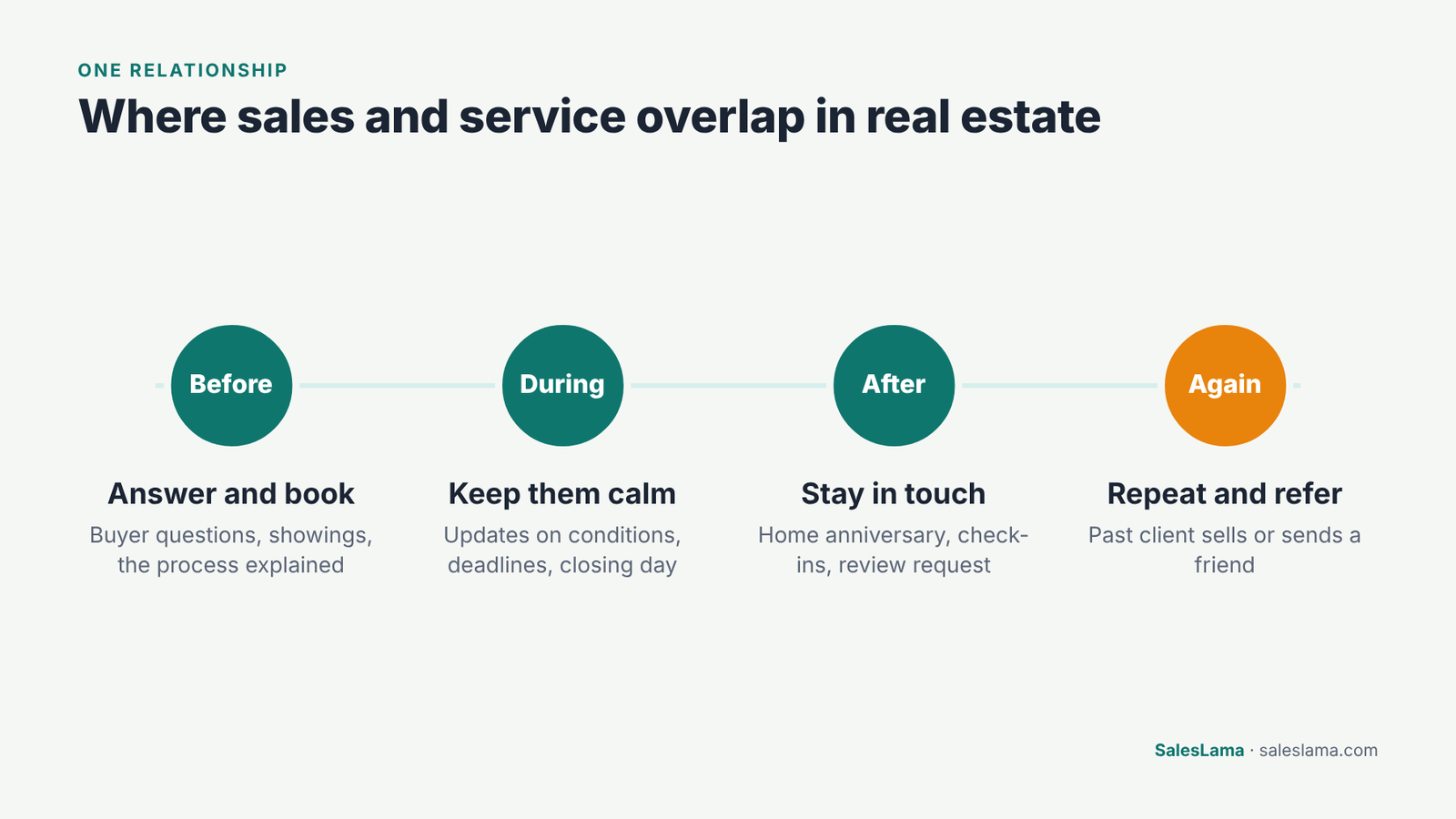
Before a sale, an agent answers buyer questions, books showings, and explains the process. That is service and sales at the same time.
During the deal, nervous buyers ask “What happens now?” again and again. Clear updates on conditions, deadlines, and closing day are customer service, and they also protect the deal.
After closing, the agent who sends a home anniversary message, checks in after a year, and asks for a review is doing service. When that past client needs to sell, or refers a friend, it becomes sales again.
Agents who treat every stage as part of the same relationship tend to get more repeat and referral business than agents who disappear after closing.
Skills Sales and Customer Service Teams Share
Sales and customer service roles call for many of the same skills. Training both teams together on these basics can improve every customer conversation.
Active listening. Whether a prospect is describing a need or a customer is describing a problem, the first job is to understand what they are really saying. Repeat back the key point before offering a solution.
Clear explanations. Customers rarely want jargon. Both teams should be able to explain products, prices, and processes in plain words.
Fast, honest replies. A quick “I do not know yet, but I will find out by 3 PM” is better than silence. Customers remember responsiveness more than almost anything else.
Empathy under pressure. Buyers can be anxious about a big decision. Customers can be frustrated when something breaks. Staying calm and acknowledging how they feel keeps the conversation productive.
Ownership. The customer should never feel passed around. Whoever picks up the conversation should either solve it or hand it over with full context and a clear promise of what happens next.
Tools That Help Sales and Customer Service
The right tools make it easier for sales and service to work as one team:
- A CRM with full customer history visible to both teams.
- A shared inbox so replies from customers are seen by whoever needs to act.
- Task management with owners and due dates.
- Automated messages for routine updates, reminders, and check-ins.
- Roles and permissions so each person sees what they need.
SalesLama is a CRM and sales operations platform that covers several of these. It includes a shared inbox for replies, team tasks with due dates and activity logs, deal pipelines, roles and permissions, and automated campaigns by email, SMS, and WhatsApp. For real estate teams, ready-made workflows such as closing-day countdown, condition deadlines, and home anniversary and reviews help keep clients informed during and after a deal. You can try SalesLama free.
Frequently Asked Questions
What is the difference between sales and customer service?
Sales focuses on helping prospects decide to buy. Customer service focuses on helping existing customers succeed and resolving their issues. Both shape how customers feel about your business.
Why is customer service important in sales?
Good service builds trust before the sale, encourages repeat purchases, and leads to referrals and positive reviews.
Should customer service agents sell?
They can suggest relevant products or upgrades when it genuinely helps the customer. Pushing sales in every support conversation usually backfires.
How do you align sales and customer service teams?
Share one customer record, create a clear handoff process, set honest expectations, pass signals between teams, meet regularly, and measure shared goals such as retention.
What tools help sales and customer service work together?
A shared CRM, shared inbox, task management, automated messaging, and clear roles and permissions all help both teams see the same information.
Related reading: for more practical guides, see managed live chat vs live chat software, ecommerce CRM strategy and bad sales habits that hurt productivity.
Final Thoughts on Sales and Customer Service
Sales and customer service have different jobs, but they serve the same customer. When they share information, set honest expectations, and hand off smoothly, customers stay longer, buy more, and recommend you to others.
If your team needs one place for customer conversations, tasks, and follow-ups, take a look at SalesLama and create a free account.
Ready to stop losing leads to slow follow-up?
SalesLama replies to new leads in seconds, follows up by email, SMS and WhatsApp, and hands hot leads to your team when they reply.