
Key takeaways
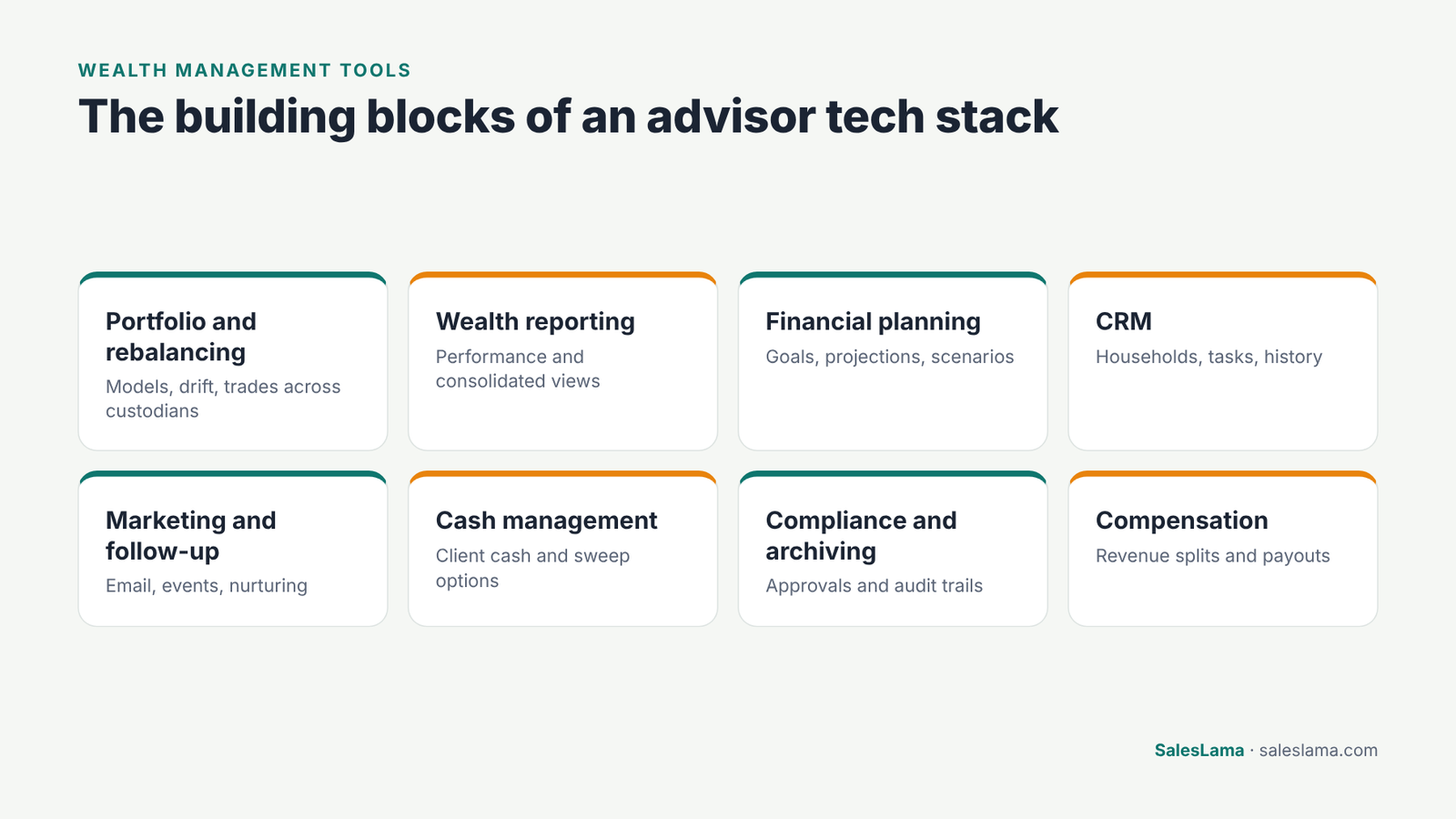
- Wealth management tools cover rebalancing, reporting, planning, CRM, marketing, cash, compliance and compensation.
- Multi-custodian rebalancing tools matter most once you manage households across several custodians.
- Start with your biggest time drain and prefer tools that integrate cleanly.
- Involve compliance early, especially for marketing and messaging tools.
Wealth management tools are software that help advisors manage portfolios, reporting, planning, client relationships and marketing. The right stack starts with your firm’s biggest time drain and favours tools that connect cleanly to your custodians and CRM.
A financial advisor’s day is split between two kinds of work. There is the client work: understanding goals, building portfolios, rebalancing, and explaining results. Then there is everything around it: data entry, reports, emails, compliance records, meeting prep, and chasing paperwork. Most advisors would rather spend more time on the first kind.
The right wealth management tools shift that balance. They handle repetitive tasks, pull data together from different custodians, and keep client communication organized. The wrong tools, or too many of them, add logins and copy-paste work.
This guide walks through the main categories of wealth management software, what each one does, and how to decide what your firm actually needs. It focuses on how to evaluate tools rather than ranking specific vendors, because the right choice depends heavily on your firm’s size, custodians, and client base.
Table of contents
- The Main Categories of Wealth Management Tools
- Multi-Custodian Rebalancing Tools
- Automated Wealth Reporting Tools
- Financial Planning Software
- CRM for Wealth Management
- Productivity Tools for Financial Advisors
- Marketing Software for Banks, Insurance and Wealth Management
- Cash Management Platforms
- Compensation Management Software
- How to Build Your Wealth Management Tech Stack
- Where Client Follow-Up Fits
- Frequently Asked Questions
- Final Thoughts
The Main Categories of Wealth Management Tools
Most firms end up with a technology stack built from a handful of categories. Some vendors offer all-in-one platforms, while others focus on one area and connect to the rest.
| Category | What it handles |
|---|---|
| Portfolio management and rebalancing | Models, drift monitoring, trade generation across accounts |
| Performance and wealth reporting | Client reports, performance calculations, consolidated views |
| Financial planning | Goals-based plans, projections, scenarios |
| CRM | Client records, households, tasks, communication history |
| Marketing and client communication | Email, newsletters, events, follow-ups, prospect nurturing |
| Cash management | Moving and holding client cash, sweep options |
| Compliance and archiving | Communication records, approvals, audit trails |
| Practice management and compensation | Revenue, payouts, advisor compensation |
Below is what each category does in practical terms.
Multi-Custodian Rebalancing Tools for Wealth Management
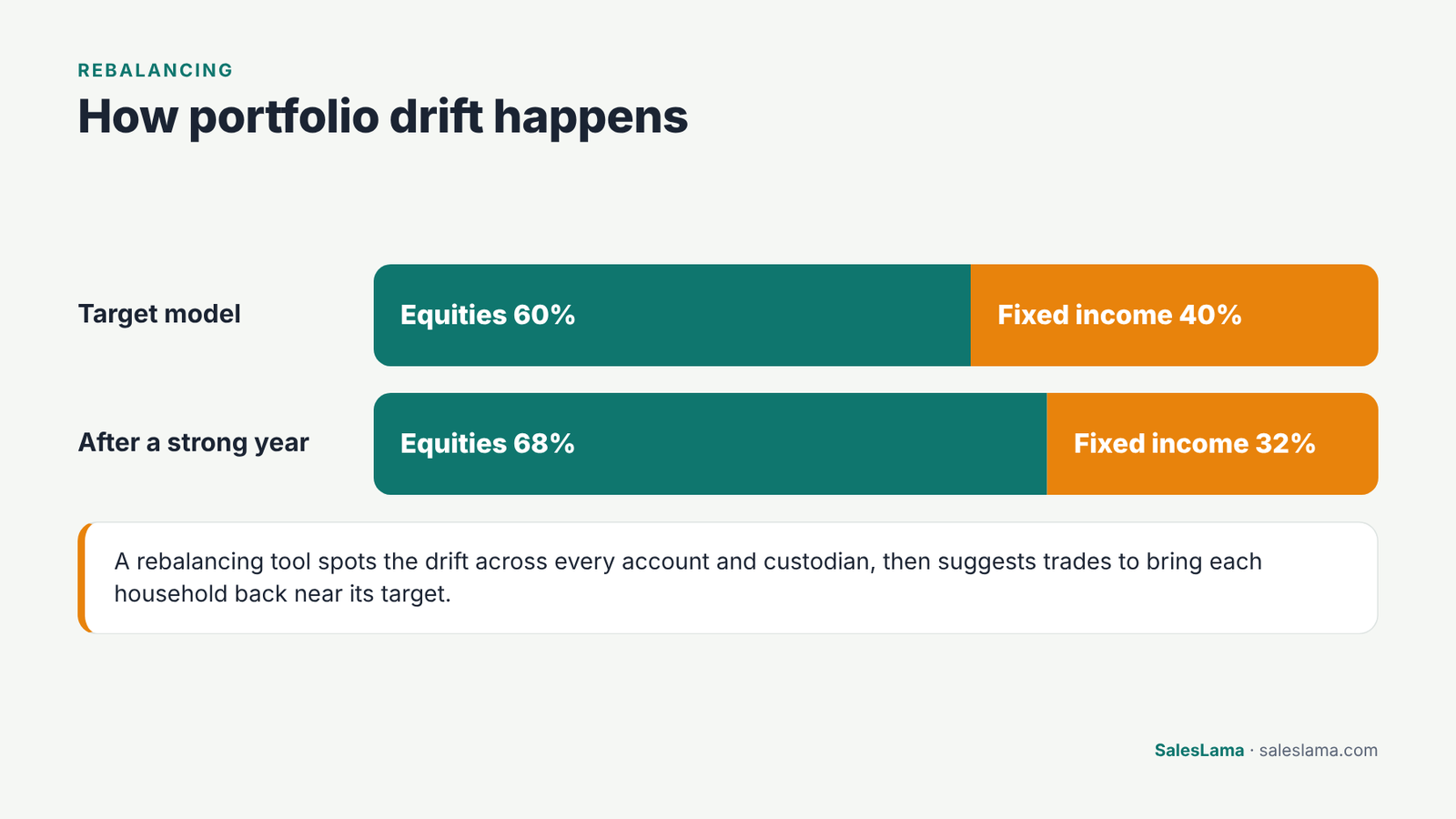
Rebalancing means bringing a portfolio back to its target allocation after markets move. If a client’s model is 60 percent equities and 40 percent fixed income, and a strong year pushes equities to 68 percent, rebalancing sells some equities and buys bonds to get back near target.
For one account, this is easy. For hundreds of households with accounts at more than one custodian, it is not. That is where multi-custodian rebalancing tools come in.
What they do
A multi-custodian rebalancing tool pulls positions from each custodian your firm uses, compares them to the assigned models, and suggests trades to bring accounts back in line. Many also handle:
- Tax awareness. Choosing which lots to sell to manage gains, and flagging possible wash sales.
- Household-level views. Treating several accounts in a household as one portfolio, so assets can be placed in the most tax-efficient account.
- Drift alerts. Notifying the advisor when an account moves too far from its target.
- Cash needs. Raising cash for withdrawals or investing new deposits according to the model.
- Restrictions. Respecting client-specific rules, such as not selling a legacy stock.
- Trade files. Generating orders in the format each custodian accepts.
How to evaluate them
When comparing the best multi-custodian rebalancing tools for wealth managers, ask:
- Does it connect to every custodian we use today, and the ones we might add?
- How often is position data updated?
- Can it handle our models, including models of models if we use them?
- How does it treat tax lots, and can we set firm-wide tax rules?
- Does it support household-level rebalancing?
- What does the trade review and approval process look like?
- How does it fit with our reporting and planning tools?
Request a demo with your own model portfolios and a sample of real accounts if possible. A tool can look great with clean demo data and struggle with your actual edge cases.
When does a firm need a multi-custodian rebalancing tool?
A: When it manages many households with accounts at more than one custodian, and manual rebalancing becomes slow or error-prone.
Automated Reporting Tools for Wealth Management
Clients want to know how they are doing. Regulators expect accurate records. Advisors need a clear picture before every meeting. Reporting tools pull data from custodians and other sources to create consolidated views and client-ready reports.
Good automated wealth reporting tools usually offer:
- Performance calculations across accounts and time periods.
- Consolidated reporting for households with assets at multiple institutions.
- Scheduled report generation, so quarterly reports are ready without manual work.
- Client portals where clients can view reports and documents.
- Custom branding so reports look like they come from your firm.
The biggest time saver is usually automation. If someone at your firm spends days each quarter building reports by hand in spreadsheets, a reporting tool can return much of that time.
Financial Planning Software
Planning tools help advisors model a client’s future: retirement income, education savings, insurance needs, estate scenarios, and so on. They turn a client’s goals into numbers and show how different decisions change the outcome.
When choosing one, think about how your advisors actually plan. Some firms prefer detailed cash-flow planning. Others prefer goals-based planning that is easier to show clients. Many tools offer both. Also check whether the planning tool connects to your CRM and portfolio data, so you are not entering the same client information twice.
CRM Tools for Wealth Management
A CRM is the central record of every client and prospect relationship. For a wealth management firm, it typically stores:
- Household and family relationships.
- Contact details, important dates, and preferences.
- Meeting notes and communication history.
- Tasks, reviews, and service workflows.
- Prospects and where they are in the onboarding process.
Some CRMs are built specifically for advisors and connect to custodians and planning tools. Others are general CRMs adapted for financial services. Either can work. The key questions are whether it fits your service process and whether your team will actually use it every day. When a client moves between advisors or teams, the CRM is also what keeps a handoff from losing context.
Related read: A CRM Handoff Should Never Lose Context
Productivity Tools for Wealth Management Advisors
Beyond the core platforms, a group of smaller productivity tools can save advisors a surprising amount of time. Common examples include:
- Scheduling tools that let clients book review meetings online without email back and forth.
- Meeting note tools that help capture and summarize meeting notes.
- E-signature tools for account forms and agreements.
- Document collection portals for gathering tax returns, statements, and IDs.
- Task and workflow tools that turn recurring processes, such as annual reviews or new account openings, into checklists with owners and due dates.
The best productivity tools for financial advisors remove small, repeated friction. Each one may save only a few minutes, but across hundreds of clients and dozens of processes, those minutes add up. Tools help most when they replace habits that drain time, like the ones in our list of bad sales habits that hurt productivity.
Marketing Software for Banks, Insurance and Wealth Management
Marketing in financial services has extra requirements. Communications may need to be reviewed, approved, and archived, depending on your regulator and your firm’s policies. Before choosing marketing software, talk to your compliance team about what records you need to keep and how approvals should work.
Within those rules, the main digital marketing tools for wealth management firms include:
- Email marketing for newsletters, market updates, and event invites.
- Prospect nurturing sequences that send a series of helpful messages to new leads over time.
- Event management for seminars and webinars.
- Website and landing page tools for capturing enquiries.
- Social media scheduling and archiving.
Banks and insurance companies often need larger systems with complex approval workflows. Smaller advisory firms can usually work with simpler tools, as long as they meet compliance and archiving requirements.
Can financial advisors use marketing automation?
A: Yes, as long as messages are reviewed, approved and archived in line with your regulator and firm policies.
Cash Management Tools for Wealth Firms
Advisor-focused cash management platforms help clients earn a return on cash held in or alongside their investment accounts, and help advisors see and manage that cash as part of the overall plan. When evaluating them, look at how they integrate with your planning tools and reporting, how client cash is held and protected, and how easy it is for clients to move money in and out. Confirm details about deposit insurance and fees directly with each provider.
Compensation Management Software
As firms grow, paying advisors correctly becomes complicated. Payouts may depend on assets under management, revenue splits, team arrangements, and production tiers. Compensation management software for wealth management firms calculates these payouts from revenue data, reduces spreadsheet errors, and gives advisors visibility into how their pay is calculated. This is most useful for firms with several advisors and more than one compensation model.
How to Choose Wealth Management Tools for Your Tech Stack
Choosing wealth management software vendors can feel overwhelming. Here is a practical approach.
Start with your biggest time drain
Ask your team where the most hours go. If it is quarterly reporting, start there. If it is rebalancing across custodians, start with a rebalancing tool. Solving the biggest problem first gives you the quickest return.
Map your data flows
Draw a simple picture of where client data enters your firm and where it needs to go. Every time someone types the same information into two systems, there is a potential integration.
Prefer tools that connect well
A slightly less feature-rich tool that integrates cleanly with your CRM and custodians often beats a powerful tool that sits on its own island.
Involve compliance early
Bring your compliance team into the evaluation, especially for marketing and communication tools. It is easier to choose a compliant tool than to fix one later.
Run a real pilot
Test with a small group of advisors and real client scenarios before rolling a tool out across the firm.
Stop losing prospects between the download and the first call
SalesLama follows up with new enquiries by email, SMS or WhatsApp and hands the conversation to an advisor when they reply.
Where Client Follow-Up Fits
One area firms often underestimate is follow-up with prospects and existing clients. A prospect downloads a retirement guide from your website, and nobody contacts them for a week. A client mentions a life event in a meeting, and the follow-up email never goes out. These gaps rarely show up in reports, but they cost relationships. A well-designed intake form and a clear follow-up process close most of them.
SalesLama is a CRM and lead automation platform that can help with this part of the stack. It captures leads from website forms, landing pages, and other tools through webhooks or Zapier and Make, then runs follow-up campaigns by email, SMS, or WhatsApp. You write the messages, set active hours, and campaigns stop when someone replies so an advisor can take over. It also supports online booking with calendar invites, team tasks with due dates, a shared inbox, birthday triggers, and roles and permissions.
SalesLama is not a portfolio management, rebalancing, or financial planning tool, and its ready-made templates are built mainly for real estate, so a wealth management firm would build its own campaigns and should confirm that its communication and archiving setup meets its compliance requirements. If prospect and client follow-up is a gap for your firm, you can try SalesLama free.
Frequently Asked Questions
What are wealth management tools?
They are software products that help advisors and firms manage client portfolios, reporting, planning, relationships, marketing, and operations.
What is a multi-custodian rebalancing tool?
It is software that pulls account data from more than one custodian, compares each account to its target model, and suggests trades to bring portfolios back in line, often with tax-aware features.
Do small advisory firms need all of these tools?
No. Most small firms start with a CRM, a planning tool, and reporting from their custodian or a reporting platform, then add rebalancing and marketing tools as they grow.
How do I choose between wealth management software vendors?
Start with your biggest operational problem, check integrations with your custodians and CRM, involve compliance early, and run a pilot with real data before committing.
Are marketing tools compliant for financial advisors?
It depends on the tool, how you use it, and your regulator’s requirements. Confirm approval and archiving requirements with your compliance team before using any marketing or messaging tool.
Related reading: for more practical guides, see CRM and sales enablement tools, how sales and customer service work together and MQL vs SQL vs PQL handoffs.
Final Thoughts
The best wealth management tools are the ones that give advisors more time with clients and less time on repetitive work. Start with your biggest bottleneck, choose tools that connect well, and build your stack step by step.
If keeping up with prospects and client follow-up is where things slip through the cracks, take a look at SalesLama and create a free account to test it with your own workflow.
Ready to stop losing leads to slow follow-up?
SalesLama replies to new leads in seconds, follows up by email, SMS and WhatsApp, and hands hot leads to your team when they reply.