
Key takeaways
- “Salesy” describes selling that feels pushy, hyped or scripted.
- It is about tone and timing, not the fact that you are selling.
- Start with the customer’s problem, be specific, and ask instead of push.
- Automated messages are not salesy if they are personal, well timed and stop on reply.
Salesy means communication that feels too pushy or hyped, focused on closing a sale rather than helping. You avoid it by leading with the customer’s situation, using plain and specific language, and letting them choose the next step.
“That email felt a bit salesy.” Most people who work in sales or marketing have heard some version of this. It is rarely meant as a compliment.
Salesy is an informal word for communication that feels too focused on making a sale. It describes a message, a person, or a website that pushes harder than the situation calls for, uses hype instead of substance, or seems more interested in closing than in helping. You will sometimes see it spelled “salesey,” but “salesy” is the more common spelling.
The tricky part is that selling itself is not the problem. People buy things every day and are happy to talk to helpful salespeople. What turns them off is a certain style. This article explains what makes something feel salesy, why it backfires, and how to sell clearly and confidently without that pushy feeling.
Table of contents
The Meaning of Salesy
When someone calls something salesy, they usually mean one or more of these things:
- It feels pushy. The message pressures the reader to act now, even when there is no real reason to hurry.
- It is all about the seller. The focus is on the product, the company, and its achievements, not on the reader’s needs.
- It uses hype. Words like “amazing,” “incredible,” “best ever,” and “once in a lifetime” appear more often than facts.
- It feels scripted. The message sounds like it was written for anyone, not for this person.
- It hides the point. The reader can tell something is being sold but cannot quite see what or why.
A salesy person might talk over a customer’s questions, steer every conversation back to the product, or use the customer’s name a little too often. A salesy website might have countdown timers on every page and pop-ups asking you to buy before you have read anything.
Salesy is about feeling, not facts
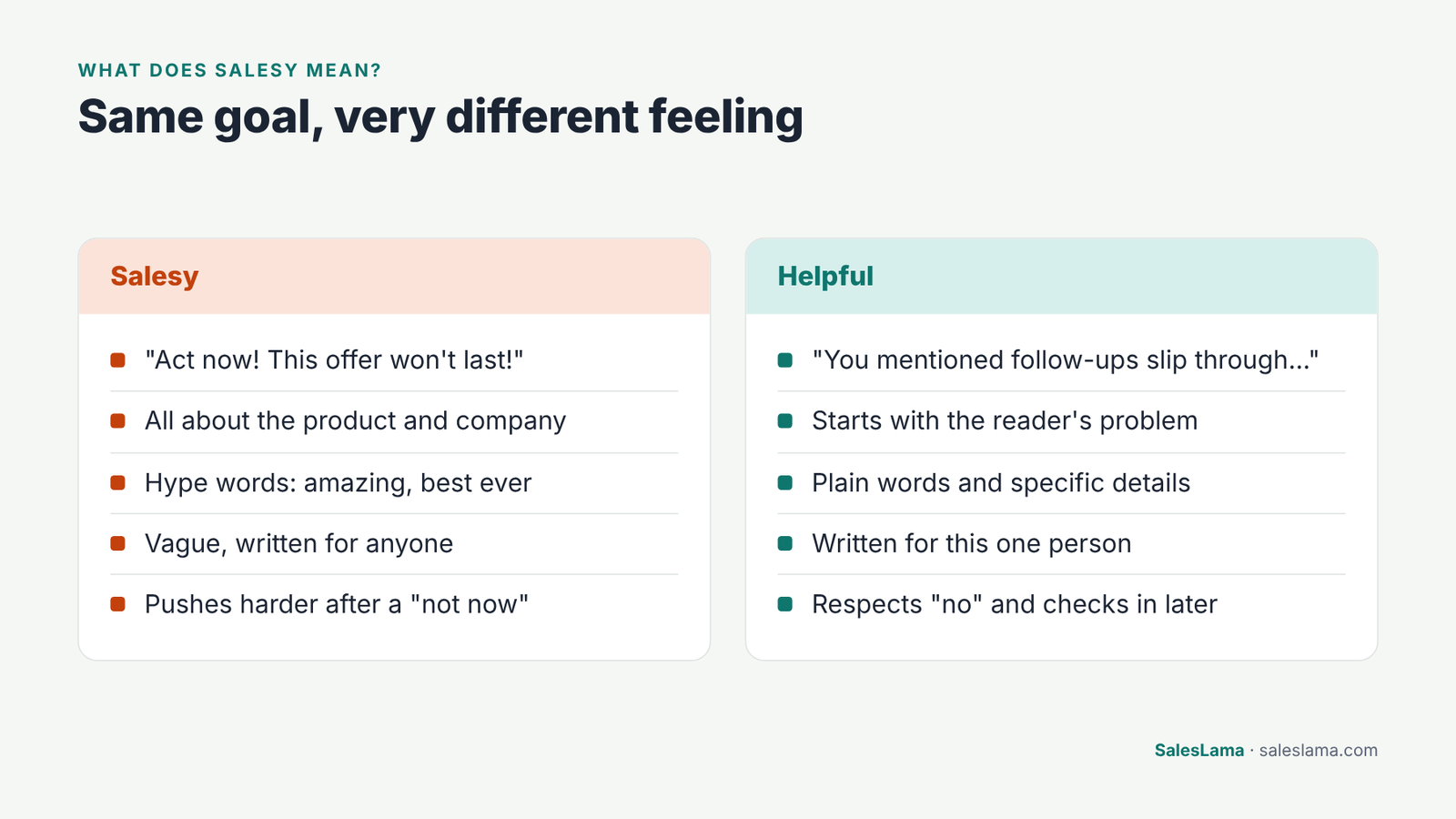
Two messages can contain the same information and feel completely different. Compare:
“Act now! This incredible offer won’t last. Our revolutionary software is the number one choice for smart businesses. Don’t miss out!”
“Hi Tom, you mentioned last week that your team keeps losing track of follow-ups. We have a tool that sends reminders automatically. Would a short demo help?”
Both are sales messages. The first feels salesy. The second feels like a helpful conversation. The difference is tone, specificity, and respect for the reader.
Is being salesy the same as selling?
A: No. Selling is helping someone decide to buy. Salesy describes a pushy, hyped or scripted way of doing it.
Why Salesy Communication Backfires
People have become very good at spotting sales tactics. They see ads all day and receive more marketing email than they could ever read. When something feels salesy, a few things tend to happen.
Salesy messages make trust drop quickly
Hype makes people suspicious. If a message promises too much, readers assume the product cannot deliver. Even if your offer is genuinely good, the salesy wrapping makes it less believable.
People stop reading salesy messages
A salesy subject line or opening sentence is a signal to skip. Readers learn to recognize the pattern and move on without giving the message a chance.
It damages relationships
In businesses that rely on referrals and repeat customers, such as real estate, trades, agencies, and professional services, one pushy interaction can end a relationship. Customers remember how you made them feel. That is one reason sales and customer service need to work as one team.
It attracts the wrong customers
Pressure tactics sometimes close a sale, but they often bring in customers who were not a good fit. Those customers are more likely to cancel, ask for refunds, or leave unhappy reviews.
Why do salesy messages get fewer replies?
A: Hype lowers trust, readers recognise the pattern and skip it, and pressure tends to attract poor-fit customers.
Common Signs Your Message Is Too Salesy
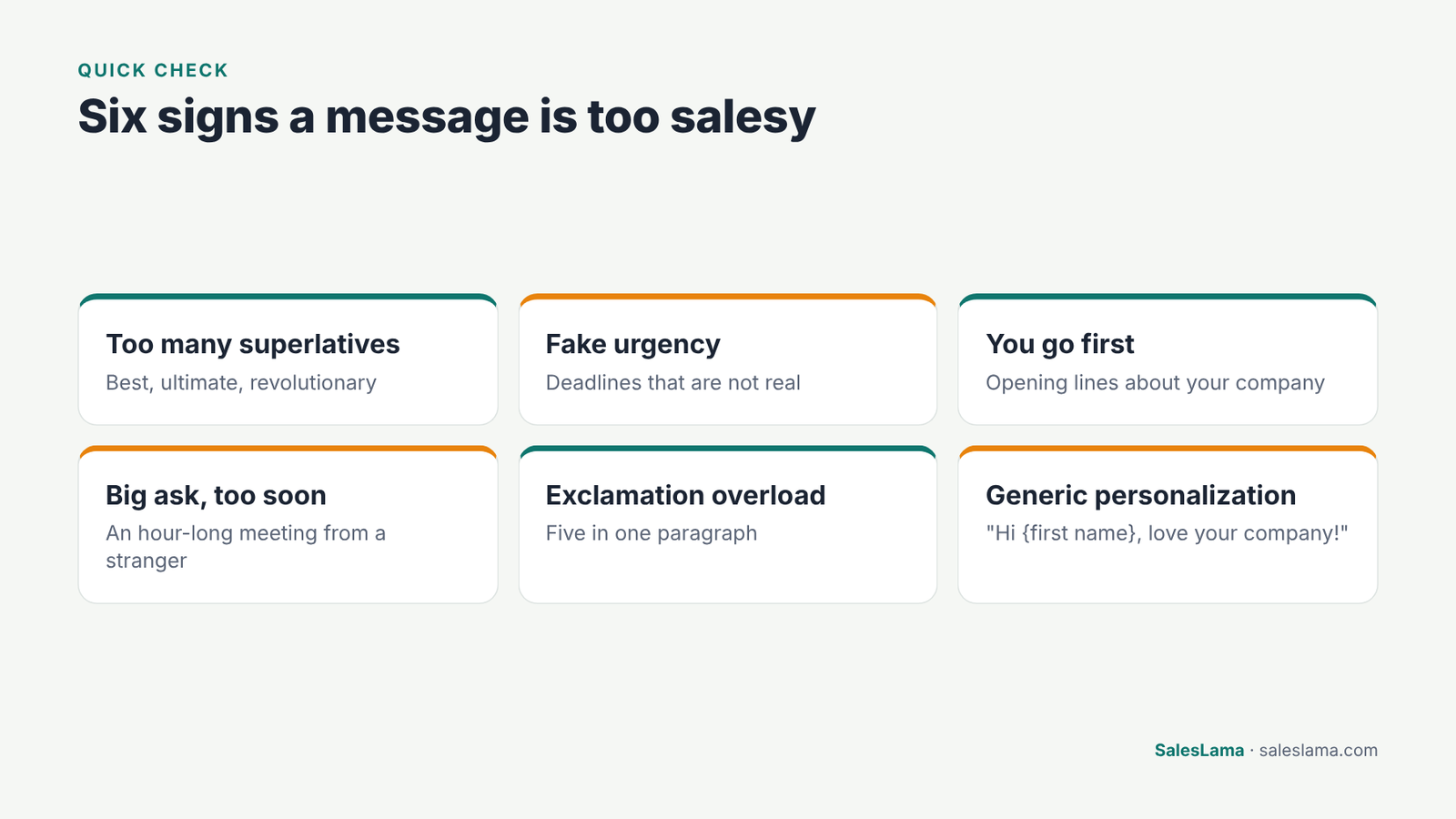
Before you send an email, post, or script, check for these warning signs.
Too many superlatives. If every sentence has “best,” “ultimate,” or “revolutionary,” cut most of them.
Fake urgency. “Only 2 spots left!” is fine if it is true. If it is not, readers usually figure it out.
Talking about yourself first. If the first three sentences are about your company, rewrite the opening around the reader.
Asking for too much too soon. Asking a stranger for an hour-long meeting in a first message feels pushy.
Exclamation marks everywhere. One can show warmth. Five in one paragraph feels like shouting.
Ignoring what the customer said. If someone tells you they are not ready to buy, and your next message pushes the same offer harder, that feels salesy.
Generic personalization. “Hi {first name}, I loved your company!” with no specific detail reads like a mass email, because it is.
How to Sell Without Sounding Salesy
The goal is not to stop selling. It is to sell in a way that feels natural and helpful. Here are practical ways to do that.
Start with the customer’s problem
Open with something the reader cares about. That could be a challenge they mentioned, a situation common in their industry, or something you noticed about their business. When the message starts with them, it feels like a conversation, not a pitch. Our sales introduction email examples show this in practice.
Be specific
Specific details make messages feel real. “We help teams follow up faster” is vague. “We send a text to new leads within seconds, even on weekends” is clear and easy to picture.
Use plain language
Write the way you would talk to a customer across the table. Short sentences, common words, and no buzzwords. If a sentence sounds like an advertisement, rewrite it.
Ask, do not push
Questions invite replies. “Would it help if I sent an example?” feels much lighter than “Book your demo today!” Let the customer choose the next step.
Share proof, not promises
Instead of claiming you are the best, show what you have done. A short example, a case study, or a description of how another customer used your product is more convincing than adjectives.
Respect “no” and “not now”
When someone says they are not interested or not ready, thank them and step back. Offer to check in later if they would like. This alone separates trusted salespeople from salesy ones.
Follow up with value
Following up is not salesy in itself. Following up with the same pitch five times is. Each follow-up should bring something new, such as a helpful article, a relevant example, or an answer to a question they asked.
Follow up consistently without sounding like a robot
Write your own messages, personalise them with real lead details, and let SalesLama stop the sequence the moment someone replies.
Salesy vs Helpful: Before and After Examples
A cold email
Salesy:
“Hi there! Are you ready to take your business to the next level? Our award-winning CRM is the best solution on the market! Book a demo NOW and see why thousands love us!”
Better:
“Hi Natalie, I noticed your agency runs lead ads on Facebook. Many teams find those leads go cold if they wait more than a few hours for a reply. We help send a personal text within seconds. Would a short example be useful?”
Want more examples like this? See our sales pitch email examples that get replies.
A follow-up message
Salesy:
“Just following up AGAIN! Did you see my last email? This offer ends Friday!”
Better:
“Hi Natalie, I put together a short example of how another agency handles weekend leads. Here it is in case it is useful. No pressure either way.”
A real estate listing message
Salesy:
“STUNNING dream home!!! You will NOT believe this INCREDIBLE property! Call now before it’s gone!!!”
Better:
“Three-bedroom home on a quiet street, five minutes from the school. New roof in 2024 and a large backyard. Open house Saturday from 1 to 3 PM.”
Related read: Sales Pitch Email Examples That Get Replies
Is Automation Salesy?
Some people worry that automated follow-ups automatically feel salesy. They do not have to. Automation is just a way of sending the right message at the right time. What makes it feel salesy is the content and the timing, not the fact that a system sent it.
Automated messages feel natural when:
- They are written in your own voice.
- They include real details, such as the property, product, or question the person asked about.
- They go out at sensible hours.
- They stop as soon as the person replies, so a human can take over.
- They do not repeat the same pitch over and over.
Automated messages feel salesy when they are generic, frequent, and keep going after the customer has already responded.
SalesLama is built around this idea. It is a CRM and lead automation platform where you write your own messages, personalize them with details like the lead’s name, property, and agent name, and send them by email, SMS, or WhatsApp. Campaigns can respect active hours and quiet hours, and they stop when a lead replies so a real person continues the conversation. That keeps follow-up consistent without sounding like a sales robot. You can try it free here.
Frequently Asked Questions
What does salesy mean?
Salesy describes communication that feels too pushy, hyped, or focused on making a sale. It usually refers to tone rather than content.
Is it “salesy” or “salesey”?
Both spellings appear, but “salesy” is more common.
Is being salesy always bad?
In most cases, yes, because it lowers trust. Being clear that you are selling something is fine. The problem is pressure, hype, and ignoring what the customer needs.
How can I make my sales emails less salesy?
Start with the reader’s situation, use plain language, be specific, ask a simple question, and remove hype words and fake urgency.
Can automated messages avoid feeling salesy?
Yes. Write them in your own voice, personalize them with real details, send them at sensible times, and stop them when the person replies.
Related reading: for more practical guides, see pitch email examples, writing a sales introduction email and bad sales habits that hurt productivity.
Final Thoughts
Salesy is less about what you sell and more about how you sell it. Pressure, hype, and generic messages make people pull away. Clear, specific, and respectful communication makes them lean in.
Focus on the customer’s problem, explain how you can help in plain words, and let them choose the next step. If you want follow-up that stays personal even when it is automated, take a look at SalesLama and create your free account.
Ready to stop losing leads to slow follow-up?
SalesLama replies to new leads in seconds, follows up by email, SMS and WhatsApp, and hands hot leads to your team when they reply.